
05/18/2024,
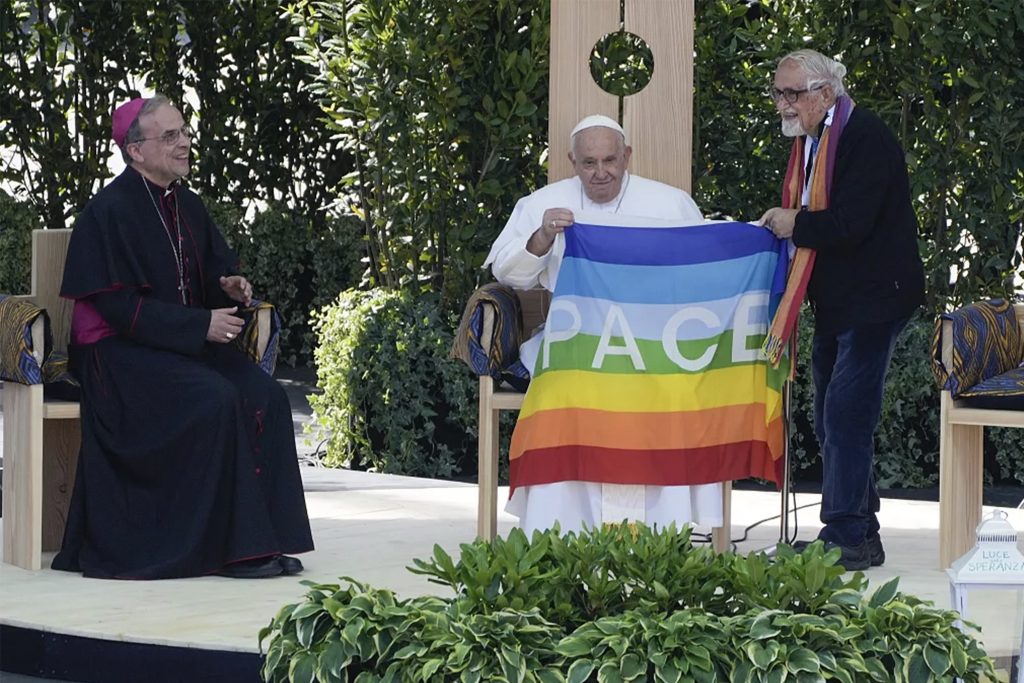
Fr.Fr. Alex Zanotelli and a group of Comboni Missionaries working in the north of Italy had the initiative of inviting other religious and civil organization that work for peace in the world, to hold an encounter in the Arena of Verona to discuss the issue. Pope Francis and several civil authorities also participated with their message of peace.
Israeli Maoz Inon whose parents were killed by Hamas on 7 October. And Palestinian Aziz Abu Sarah, who mourns a brother who died under the blows of the Israeli army in the ongoing war in Gaza.
They embraced in front of Pope Francis, to express their desire for peace but also to indicate the only way to achieve it. It happened this morning at the Verona Arena packed with 12,000 people gathered for the ‘Arena of Peace’, the meeting promoted by the Comboni Missionaries, Italian pacifist and social initiative movements at which Pope Francis wanted to be present.
‘Invisible grains of dust to block the infernal machine and build justice and peace’, defined these people as Don Luigi Ciotti, president of the Libera association against mafias, presenting them to the pontiff.
This powerful gesture of Maoz and Aziz – together with the video appeals sent by some women from the Israeli Women Wage Peace movement and the Palestinian Women of the Sun – that set the tone for the morning spent by the pontiff with those ‘popular movements’ that he has repeatedly indicated as prophecies of a fairer world, starting from the little ones and the concrete lives of people.
Seated next to him – together with the bishop of Verona Monsignor Domenico Pompili – was Comboni missionary Fr. Alex Zanotelli, for many years the voice of the last in the peripheries of Kenya and the historical face of Italian pacifism. A
On the stage – with so many realities committed to the issues of participation, care for the environment, work, disarmament, migration – Afghan Mahbouba Seraj (who denounced ‘the illusion and failure of a peace that was being imposed from above’), Vanessa Nakate, a young Ugandan climate activist, and Pedro Stedile, from the Brazilian landless movement, also brought their experience.
In a close dialogue during which he often abandoned the prepared text to add his own thoughts off the cuff, Francis denounced plagues such as child labour, the arms trade, indifference (‘the Nobel prize we could give to so many of us is that of Pontius Pilate’).
‘Peace cannot be invented from one day to the next, it must be nurtured,’ he added, pointing the way to a dialogue ‘that does not anaesthetise or remove conflicts’. ‘Not being afraid of conflicts is the richness of society,’ he added, ‘Dialogue always helps us, but not to make everything equal. The sin of political regimes that ended in dictatorships is not to admit plurality. A society without conflict is a dead society; only a society where we take conflict by the hand and dialogue is a society that has a future’.
‘We are both entrepreneurs,’ the Israeli Maoz Inon and the Palestinian Aziz Abu Sarah told the pope on their part, ‘and we believe that peace is the greatest undertaking to be achieved. There can be no peace without an economy of peace, an economy that does not kill. An economy that does not produce war, but is instead based on justice. But how can young people be entrepreneurs of peace when the places of formation are influenced by technocratic paradigms and the culture of profit at any cost?’
Pope Francis did not answer this question directly, but invited us to look at ‘the experience of these two brothers, which is the suffering of the two peoples.
They,’ he added, ’had the courage to embrace each other. Theirs is not only courage and a testimony of peace; embracing each other is also a project for the future. Both have lost family members, their families are broken because of this war. What is the point? Let us be silent and, looking at this embrace, let each one pray and decide within himself to do something to end wars’.
He also reiterated his conviction that ‘the future of humanity is not only in the hands of great leaders, great powers and elites’, but ‘in the hands of the peoples, in their ability to organise themselves’ giving voice to change.
‘Everyone will reap what they have sown,’ he added, ‘Our civilisations are sowing death, destruction, fear. Instead we sow hope. That is what you are also doing, in this Peace Arena. Do not stop. Do not become discouraged. Do not become spectators of the so-called ‘inevitable’ war. As Bishop Tonino Bello used to say,‘ he concluded, “Arise builders of peace”’.