
Basic Formation
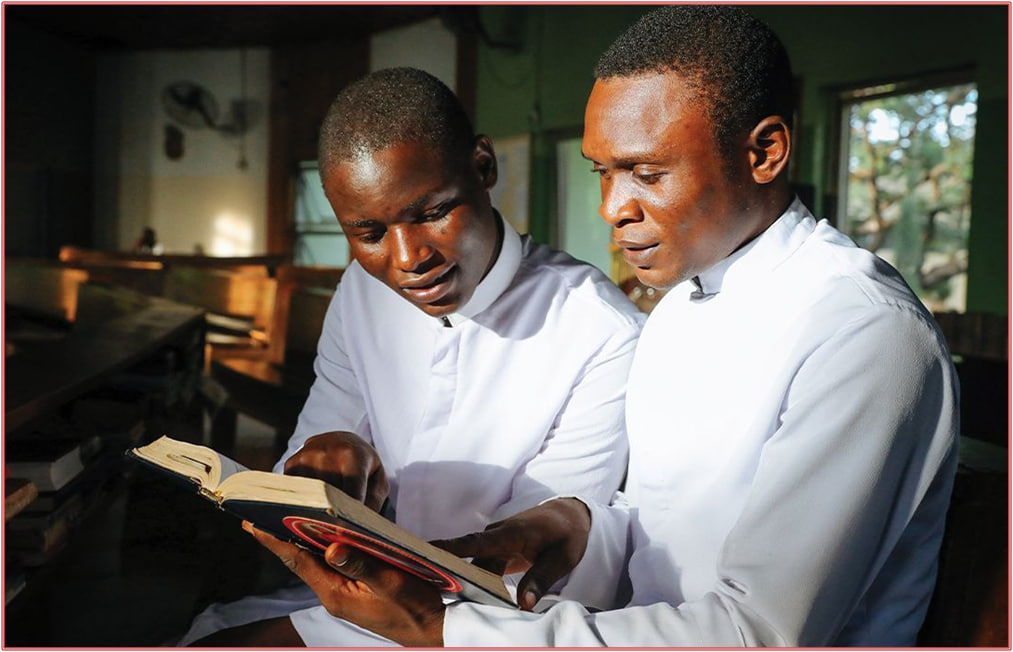
The formation of candidates for missionary life, whether as a Religious Brother or a Priest has a big importance in the Province. The formation directors make their availabilities and missionary passion to form,at all levels, the candidates who arrive to the seminary.
Stages of the formation process
After a young boy with missionary call got in touch with the vocation promoter and was accepted to start the process of formation, he follows the following phases of formation to become a committed Comboni Missionary:
A – Pre-postulancy
A six months period in the seminary to give deeper formation to the candidates, either for those who fell to become Religious Brothers or Priest, in the following areas:
- To cultivate in themhuman and Christian values with testimony and lessons.
- To accompany them in their process of discernment about their vocation.
- To provide information about the Comboni Missionaries and their founder to see if theyfeel identify with this vocation.
B – Postulancy
In this stage, the formation director presents to the postulant, the young seminarian, a formation that may nurture in him the assimilation of gospel values and the Comboni spirituality-identification.For their education…
- The candidate to be a Brother studies in a school thatprovides technical and human training.
- The candidate to become a Priest studies philosophy, the basic study before theology.
C – Novitiate
The aim of this stage is to accompany the candidate for two years in his spiritual and vocational journey.
- This stage of formation is followed in another African country, Malawi or Gana, to foster in him the sense of internationality, proper of the missionary vocation.
- The novitiate concludes with the decision of the young seminarian to follow other style of life or to consecrate his life to God according to the style of mission lived by Saint Daniel Comboni.
- The novice consecrates his life to God for the service of the mission by making profession of the vows (obedience, poverty, and chastity) that are repeated yearly during the following stage of basic formation.
D – Scholasticate and International Brother Center (IBC)
Like in the stage of Postulancy, the candidates to become Comboni Missionaries follow two different houses of formation to increase their spirituality, their vocational dimension, and their human values that will help them to give better service.
- The ‘scholastic’, the candidate to priesthood, studies theology, while the candidate to Brother studies in a technical school or university.
- The formation of the candidate continues in a foreigner country to keep on developing the sense of the universality of the church.
- Every year he renews his vows for a year until he may finish his process of formation in the seminary. This is the reason these vows are also called ‘temporal-vows’.
E – Missionary service
After concluding his academic formation, the candidate returns to Ethiopia where he will give a service for two years in one of the missions.
- There, he will obtain experience as a missionary while serving. He will also share the gifts God has giving to him, for the growth of the religious and Christian communities.
- At the end of this period, the candidate will be ready to request his desire to make the perpetual vows, consecrating all his life, in this way, to God for the service of the mission.
F – Final Vows and Ordination
The final stage of the Basic Formation (immediately, his On-Going formation will start) is the final vow for both, the candidate to be a Brother or be a priest.
- He will make his request to be accepted fully and for all his life in the Institute of the Comboni Missionaries following all his norms and directives.
- The candidate to becomes a Religious Brother, after his perpetual vows, will be sent soon after to a mission in Ethiopia or in another country.
The candidate to priesthood is ordained first as a deacon, serves a Christian community for at least six months, and then receives the order of priesthood. From there, he will be sent to another country or to a mission in Ethiopia to start living out his missionary vocation.