
Comboni’s Short Life but Large Missionary Activity

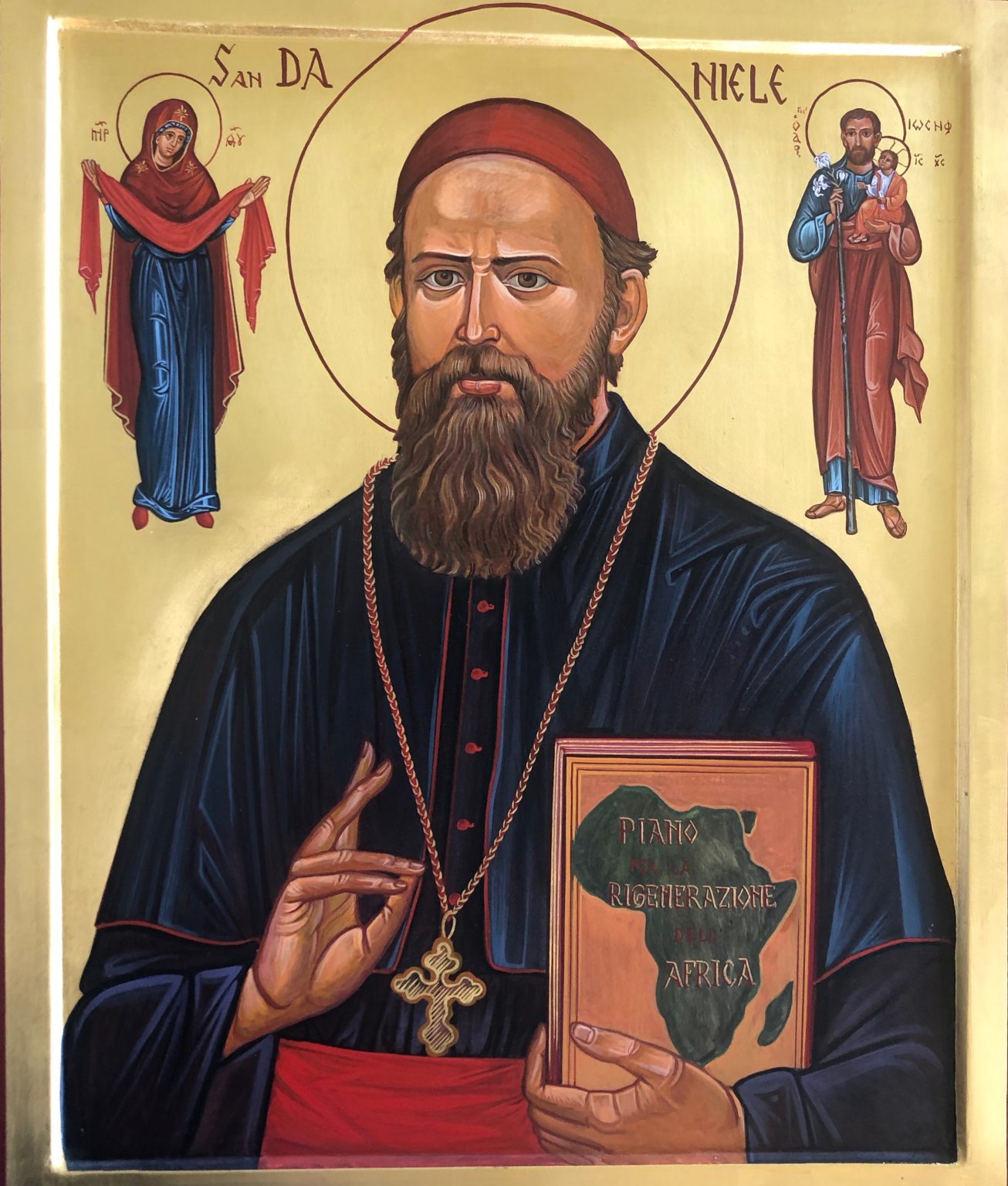
Saint Daniel Comboni was born on 15 March 1831 in Limonesul Garda, Italy, and died on 10 October 1881, at aged 50, in Khartoum, Sudan, Africa. He was Beatified on 17 March 1996 and Canonized on 5 October 2003, in Rome by Pope John Paul II. His feast day according to the Roman Liturgical Calendar is on 10 October.
Comboni was born into a family ofpaid cultivators, and he was the only survivor of all his 8 brothers born of Domenica and Luigi Comboni.
He joined the Institute founded by Father Nicola Mazza in Verona, a school for poor children, where he discovered his calling to priesthood and missionary life, listening the experiences of Fr. Mazza Institute’s missionaries evangelizing in Central Africa.
On December 31st, 1854, Daniel was ordained as a priest and in 1857 and left for Africa along with five other missionaries of the Mazza Institute. After four long months, the missionaries reached Khartoum, capital of the Sudan.
The impact of this first face-to-face encounter with Africa was tremendous; Daniel was immediately made aware of the multiple difficulties that were part of his new mission. Labors, the unbearable climate, sickness, the deaths of several of his young fellow-missionaries, the poverty and the dereliction of the population were not an obstacle for him to desist the vocation that he has taken on with such great enthusiasm.
From the mission of Holy Cross, he wrote to his parents:
“We will have to labor hard, to sweat, to die. But the thought that one sweats and dies for love of Jesus Christ and the salvation of the most abandoned souls in the world, is far too sweet for us to desist from this great enterprise”.
After witnessing at the death of another of his missionary companions, Daniel, far from being again discouraged, felt an interior confirmation of his decision to carry on in the mission, as he wrote:
“O Nigrizia o morte!”— “Either Africa, or death”.
However, considering all the difficulties and challenges that him and allthe missionaries were facing in the African continent, when he returned to Italy, he prayed God to enlighten with a new and fresh missionary strategy. In 1864, while praying at the Tomb of Saint Peter in Rome, hereceived an inspiration that led him to draw up his “Plan for the Rebirth of Africa”, a missionary strategy, a project that can be summed up in an expression which is itself the indication of his boundless trust in the human and religious capacities of the African peoples:
“To save Africa through Africa.”
Asan original missionary, Daniel strove to drive ‘home’ his intuition: that both, the European societyand the Church, were called to become much more involved in the evangelization of Central Africa. For that reason, he undertook a tireless round of missionary animation and financial appeals throughout Europe, requesting help for the African missions, from Kings and Queens, Bishops, and nobles, as well as from the poor and simple people. With the aim of creating missionary awareness, he launched a missionary magazine, the first in Italy.
In 1877 and 1878 he and the missionaries in Africa were tormented in body and spirit by the tragedy of a drought, followed by mass starvation without precedent, and he returned to Italy.
In 1880, with steadfast determination, Bishop Comboni travelled to Africa, for his eighth and final trip, with three objectives in mind:
- To stand alongside his missionaries and evangelize.
- To continue the struggle against the malignant and pernicious Slave Trade in Africa.
- To reinforce his plan of consolidating the missionary activity carried out by Africans themselves, to save Africa with Africans.
A year later, overwhelmed by his differenthard tasks, by the death in quick succession of many of his missionaries, and by the illness he started suffering from, he became very weak himself.
On 10 October 1881, when he was only 50 years old, he died in Khartoum. He died among the people he decided to give his life for and whom he loved deeply. He was aware of the missionary passion of his collaborators and the seed of evangelization that he had already planted in the hearts of the institutes he founded, in his new African Christians and in the whole church. Before dying he declared that his work would notend with him. He said:
“I am dying”, he says, “but my work will not die.”
See animated video about his life: https://youtu.be/NecPJHEEz_Q?feature=shared
In the following lines, we will see with more detail the main dates and events of his 50 years of life:
1831, March 15: | Daniel Comboni wasborn in Limone sul Garda (Italia). |
1843, February 20: | He entered the Institute Don Nicola Mazza, a school to educate poor students”. |
1849, January 6: | In the presence of Don Mazza, he vowed to consecrate his life to the mission. |
December 31: | He was ordained as a priest. |
September 10: | He made his first journey to Central Africa. |
1859, January 15: | The missionaries of Don Mazza and Comboni returned to Italy, racked by fever. |
1861, January 12: | Back in Africa (Aden), he ransomed young African slaves to educate them in Italy Verona.) |
1864, September 15: | At St. Peter’s tomb, in Rome, he conceived his Plan for the Regeneration of Africa while praying. |
1864, September 18: | After the beatification of Margaret Mary Alacoque, he presented his Plan to the Vatican (Prefect of Propaganda Fide.) The following day, he presented it to Pope Pious IX. |
1864, December: | He journeyed for missionary animation to Turin, Lyons, Paris, Cologne, and London to make his Plan known and invite other institutes to send missionaries to Africa. |
1866, Abril 13: | He decided to become a founder of a Missionary Institute for the mission after he heard that the Mazza Institute renounced its missionary commitment to Africa. |
1867, June 1: | He founded in Verona the Missionary Institute for Africa as a part of the Organization of the Good Shepherd, an international missionary association. |
1867, November 29: | He left from Marseilles to Africa with three Camillians, three Sisters of St. Joseph of the Apparition missionaries and 16 young African women. |
1868, July 7: | He made Missionary Animation awareness in France, Germany, Austria, and Italy. |
1869, May 23: | He opened a third house in Cairo which is to be a school with African teachers. |
1870, Junio 24: | He prepared a document about his plan to present it to the Council Fathers, “Postulatum pro Nigris Africae Centralis”, that he sends together with a circular letter signed by numerous Bishops and approved by Pope Pius IX. |
1871, September 14: | He speaks on the theme of “Africa or death” at the congress of German Catholics in Mainz, Germany. |
1872, January 1: | He founded the Institute of the Pie MadridellaNigrizia’, in Verona. In the same month, he began his missionary magazine, “The annals of the Good Shepherd”. |
1872, May 26: | He is nominated Pro-Vicar of Central Africa. |
1872, June 1: | Pope Pius IX entrusts the mission of Central Africa to Comboni. |
1873, January 26: | He leaves Cairo, Egypt and reaches Khartoum and Kordofan in Sudan. For the first time European Religious form part of the expedition. |
1876, October 15: | Back in Verona, Italy, he received the vows of the first Pie MadridellaNigrizia. |
1877, August 12: | He receives the Episcopal Consecration as Vicar of Central Africa. |
1877, December 15: | He left for Africa with five priests, six brothers and five Pie MadridellaNigrizia. |
1881, July 30: | In Khartoum he had the the intention of presenting to Rauf Pascià, an Egyptian officer, a plan for the total abolition of slavery in the Nuban region. |
1881, October 5: | He was attacked by a strong fever. |
1881, October 10: | He dies at 10 in the evening in Khartoum, surrounded by his missionaries. |
1885: | His tomb was desecrated by the Mahdists, searching most probably for valuables. |
1927: | The cause for his beatification and canonization is presented in Verona. |
1969, January 6: | Comboni’s third institute, the Secular Comboni Missionaries, received canonical recognition. |
1996, March 17: | He was beatified in the Basilica of St. Peter in Rome. |
2003, October 5: | He was canonized by Pope John Paul II in the Basilica of St Peter in Rome. |
See animated video about his life: https://youtu.be/NecPJHEEz_Q?feature=shared