
Pope Francis is embarking on the longest, arguably most grueling trip of his pontificate: a 12-day sprawling tour that will take him to four missionary countries: Indonesia, Papua New Guinea, Timor-Leste, and Singapore.
Traveling on an ITA Airways plane, Pope Francis set off on the longest foreign trip of his papacy.
The plane carrying the pope, top Vatican officials and about 75 journalists took off from Rome’s Fiumicino airport Sept. 2 on what was scheduled to be a 13-hour flight to Jakarta, Indonesia, the first stop on the pope’s four-nation apostolic visit.
The 87-year-old pope was expected to cover more than 20,000 miles during his visit Sept. 2-13 to Indonesia, Papua New Guinea, Timor-Leste and Singapore.
Cardinal Luis Antonio Tagle, pro-prefect of the Dicastery for Evangelization and a member of the papal entourage, told Fides, his dicastery’s news agency, that the pope is not trying to set a record or prove a point about his stamina.
Rather, he said, subjecting himself to the rigors of such a long trip “is an act of humility before the Lord who calls us — an act of humility and obedience to the mission.”
Pope Francis “wants to encourage Catholics in all the contexts in which they find themselves,” the cardinal said in the interview published Aug. 27. “Asia is home to two-thirds of the world’s population. The majority of these people are poor. And there are many baptisms among the poor. Pope Francis knows that there are many poor in those areas, and among the poor there is an attraction to the figure of Jesus and to the Gospel, even in the midst of war, persecution and conflict.”
Interreligious dialogue, care for creation and the fair treatment of immigrants are expected to be issues the pope touches on in each of the four countries. He is also likely to call on local Catholics to pick up the missionary mantle, building on the work of the missionaries who first shared the faith and, in many cases, built networks of schools and hospitals.
Indonesia is a predominantly Muslim nation, and Catholics account for only about 3% of the population. Almost all the people of Papua New Guinea are Christian and about 30% of them are Catholic. Timor-Leste is the only nation on the itinerary where Catholics are the majority; the Vatican estimates that 96% of the population belongs to the church. In Singapore, Buddhists make up the largest religious group — about 31% — followed by 20% of the population claiming no religious belief; Christians account for almost 19% of the population and Muslims about 15%.
Archbishop Paul R. Gallagher, the Vatican foreign minister, told the Italian magazine L’Espresso that the trip “incarnates” Pope Francis’ constant call for Catholics to go out to the “peripheries.”
The trip to Asia and Oceania, he said, does so “certainly from a geographical point of view, but also in light of the great cultural and religious diversity of the countries he will visit. From this perspective, the trip represents the concern and closeness of the Holy Father to everyone — Catholics and non-Catholics — based on the conviction that we are ‘fratelli tutti'” — all brothers and sisters.
Care for creation will be another big theme of the visit, he said, particularly because all four countries are island nations exposed to the dangers of rising sea levels. In fact, Indonesia is building a new capital city to replace Jakarta, which is known as “the fastest-sinking megacity on the planet.”
CATHOLIC NEWS SERVICE
Cindy Wooden
September 2, 2024
Note:
All three countries have in common the fact that the Church here is missionary: either too young, too small, or too poor to be self-sufficient.
First stop: Indonesia
As all the dioceses of Indonesia are young Churches, they are considered mission territories. For this reason, each year, they receive help from The Pontifical Mission Societies raised throughout the world with initiatives such as World Mission Sunday (October 20th). TPMS has supported evangelization in Indonesia in the past five years with $14 million. These funds have been used to pay for the education of 3,631 seminarians, building outpatient clinics, boarding schools for girls, buying bibles, and training catechists.
Second stop: Papua New Guinea
Close to 32% of the population of Papua New Guinea is Catholic, totaling some two million people. The Catholic Church plays a vital role in the country, providing spiritual guidance and essential services in education, healthcare, and social welfare. Despite being a minority religion, the Church’s influence extends into many aspects of daily life, fostering community development and advocating for justice and human rights.
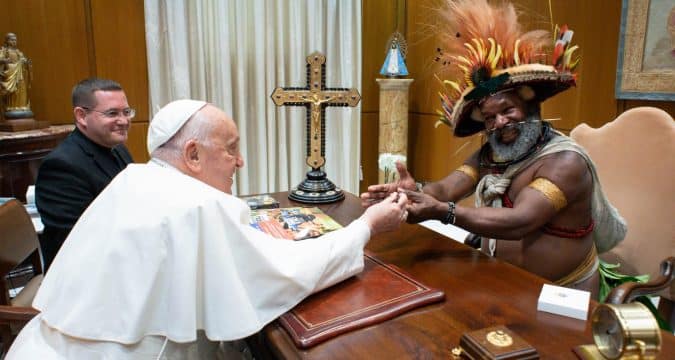
Pope Francis’ visit to Papua New Guinea will a historic moment for the nation, as he brings Christ’s message of hope, faith, and solidarity to the peripheries of the Catholic world. This visit underscores his commitment to reaching out to those often overlooked. As the national director of The Pontifical Mission Societies–Papua New Guinea, Fr. Victor Roche, SVD, shared, “Pope Francis is particularly stressing those places which are on the peripheries, dioceses, and countries that are usually not recognized or remembered for any significance.”
Third stop: Timor-Leste
The Catholic Church in Timor-Leste has been a steadfast presence for over 500 years, dating back to the early Portuguese missionaries. During the Indonesian occupation and the subsequent struggle for independence, the Church played a pivotal role in unifying the people and advocating for their rights on the international stage.
Today, the Church continues to be a cornerstone of the community, providing not only spiritual guidance but also essential social services. An estimated 98% of the total population of 1.3 million is Catholic.
Fourth stop: Singapore
Following British colonization in 1819, the first Catholic priest reached Singapore in 1821. Father Laurent Imbert—a French missionary who would become a saint after his martyrdom in Korea—discovered Catholics already living on the island. Thereafter, French and Portuguese missionaries arrived and ministered in Singapore, planting the seeds for both faith and the Church to grow. In addition to announcing the good news of Jesus Christ, the Church continues to contribute to the social cohesiveness of Singapore through active participation in interreligious dialogue, as well as in shaping the moral fiber of our society by championing family values and the dignity of life.
In Singapore, Buddhists make up the largest religious group — about 31% — followed by 20% of the population claiming no religious belief; Christians account for almost 19% of the population and Muslims about 15%.