
Spirituality
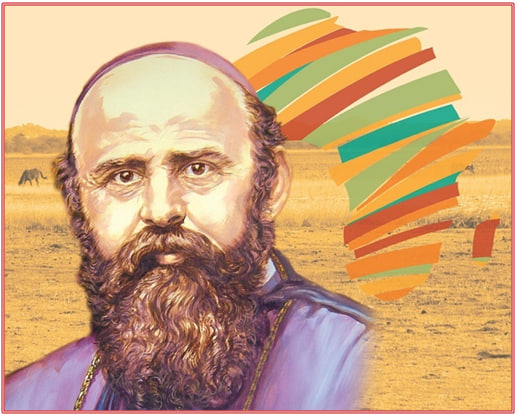
Saint Daniel Comboni’s spirituality is rich and multifaceted that can be found in many of the letters he wrote and in the style of life he transmitted to the members of the congregations founded.Here are eight key elements that are part of his spirituality, elements that shaped his approach to faith and mission:
1. The Pierced Heart of Christ the Good Shepherd: Central to Comboni’s spirituality was contemplating the
compassionate love of Jesus, the Good Shepherd who sacrificed himself for humanity. This contemplation
fueled his own passion for Africa, believing Jesus’ heart yearned for its people too.
2. Love of the Cross : For Comboni, embracing the challenges and hardships of mission life wasn’t something
to avoid, but a way to follow Christ. He saw the cross as a path to fruitfulness, believing that suffering united
him to the crucified Christ and ultimately served the greater good of evangelization.
3. Zeal for Evangelization: Comboni burned with a fiery passion to spread the Gospel, particularly to the most
neglected regions like Central Africa. This zeal wasn’t simply about geographical expansion, but about a
burning love for God and a desire to share that love with others.
4. Intercultural Dialogue and Inculturation: Comboni emphasized respect for African cultures and traditions.
He believed the Gospel message should be presented in a way that resonated with local contexts, fostering
a genuine exchange and integration of faith and culture.
[This element is not explicitly mentioned literally in his writings but can be found in Comboni Missionary
understanding.]
5. Unity and Collaboration: Comboni envisioned a missionary society where priests, sisters, and laypeople
would work together as a united family. He believed this collaboration was essential for effective
evangelization and for fostering a strong sense of community.
6. Promotion of Justice and Dignity : Comboni wasn’t just concerned with spiritual well-being; he fought
against slavery and social injustices. He believed that sharing the Gospel necessarily involved promoting
human dignity and advocating for the oppressed.
7. Spirit of Sacrifice and Austerity: Comboni lived simply and expected the same from his missionaries. He
believed material possessions were a distraction from their true mission. This wasn’t about self-mortification,
but about prioritizing their spiritual call and living in solidarity with those they served.
8. Missionary Martyrdom: While not seeking death, Comboni wasn’t afraid of the possibility of martyrdom. He
believed that the ultimate act of love was to give one’s life for the mission. This willingness to die for the cause
fueled his commitment and inspired his followers.
These eight elements provide a glimpse into the depths of Saint Daniel Comboni’s faith and the core
values that guided his missionary work.
Method of evangelization based on his spirituality
Also in his own words, Comboni makes know the fundamental message of his Methodology of Evangelization for all his missionaries, which are the clear reflection of his communion with Dos and form part of his spirituality. Here are some of his main quotes:
“To Save Africa with Africa…”
- Comboni.He fixed his sight on the poor of Africa; he saw them as the most marginalized and the poorest people of his time. He wanted them to take an active part in their future and destiny.
- His Missionaries.We live this phrase today with high consideration because it requests from us to give confidence to the people in our Christian communities, so that they may become protagonists of their own process of liberation and evangelization.
“To Make Common Cause with The People…”
- Comboni: With this simple sentence, he expected his missionaries to have a lifestyle that was simple, to share the joys and sorrows with those that were considered the “least” and to be prophetic voice for those who have no voice.
- His missionaries.We live in solidarity the poor, sharing their life and destiny in the missions we are present around the world. Being in communion with them can, at times, lead to persecution and even martyrdom. With Comboni’s motivation, our desire to “live with” and not simply “visit” the people to whom we are sent.
“To Evangelize as a Community…”
- Comboni. In the proposal for all his missionaries, to be a “cenacle of apostles”, he he wanted to emphasize the importance of living like the first Christian Community we find in the Acts of the Apostles.
- His missionaries. We do not only witness the gospel by ourselves alone, but we do it, even more authentically and powerfully, as a community, united in prayer and for the service of the people. Being communities that are international, we also witness the catholic/universal dimension of the church.
“The missionaries keep their eyes fixed on Jesus Christ, loving him tenderly,
seeking to understand the meaning of a God who died on the Cross”.
Daniel Comboni, 1872.
Daniel Comboni, a spiritual person
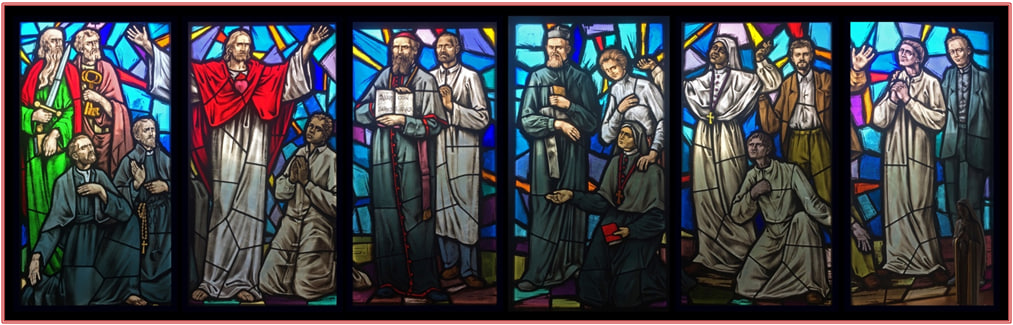
The spiritual person is one who follows and embracesthe life of Christ, living according to his Spirit, and bearing the first fruit of his communion: alove that pours out from the pierced heart of Jesus on the Cross.In Saint Daniel Comboni we clearly find the profile of a spiritual person.
a/ Comboni sees Africa with the eyes of faith
This element is seen the text he wrote on September 15, 1864: “The Catholic, accustomed to judging things by the light that comes from above, looked at Africa not through the miserable prism of human interests, but with the ray of faith; and he saw there a great multitude of brethren belonging to his own family, having a common Father in heaven, bowing, and groaning under the yoke of Satan. Then he let himself be carried away by the impetus of that charity lit with the divine fire on the slope of Golgotha, and when he left the side of a Crucified, to embrace the entire human family, he felt the more frequent beats of his heart; and a divine virtue seemed to drive him to those barbaric lands, to hold him in his arms and give the kiss of peace and love to the unhappy brothers” (S 2742-2743).
b/ God is ‘everything’ for Comboni
In the hundreds of letters that Comboni wrote, we can persive him as an altruistic, enterprising person, tireless in his activity and believer, deeply open to “self-transcendence”: God is present in him in capital letters, he is the “Everything” of his life, the which gives reason for his total dedication to the missionary cause among the peoples of Central Africa (cf. RV 2-5).
c/ The strong feeling of God in Comboni
Although he is an extroverted type, committed to the conquest of Africa to Christ (“Oh Africa or Death”), in his “deep self” he encounters and experiences a “strong feeling of God” and manages to discover and welcome it in all aspects of his life and in the people he meets, especially those to whom God himself entrusts him.His encounter with God is so profound that his “I” disappears and Comboni simply becomes “the Catholic, accustomed to judging things by the light that rains on him” (S 2742) in a constant attitude of discernment.
d/ The taste of God drives Comboni to bring salvation
By virtue of this inclination, Comboni cannot live without God, he has a taste for the search for God, for what concerns him, for his plan for the salvation of the world and for what is preferred by him, that is, “the neediest and abandoned in the Universe” (Rules of 1871, Cap. I; S 2647). That is why he is willing to risk his life with Him to the extreme consequences. Therefore, his thoughts and feelings are absorbed by God’s thoughts and feelings. God is the end of him last of him; Therefore, he lives impregnated with “a strong feeling of God” and with a lively desire to live in this world in harmony with him and to contemplate his face in Eternity.
A summary from a reflection by Father Carmelo CasileMCCJ, 2017.