
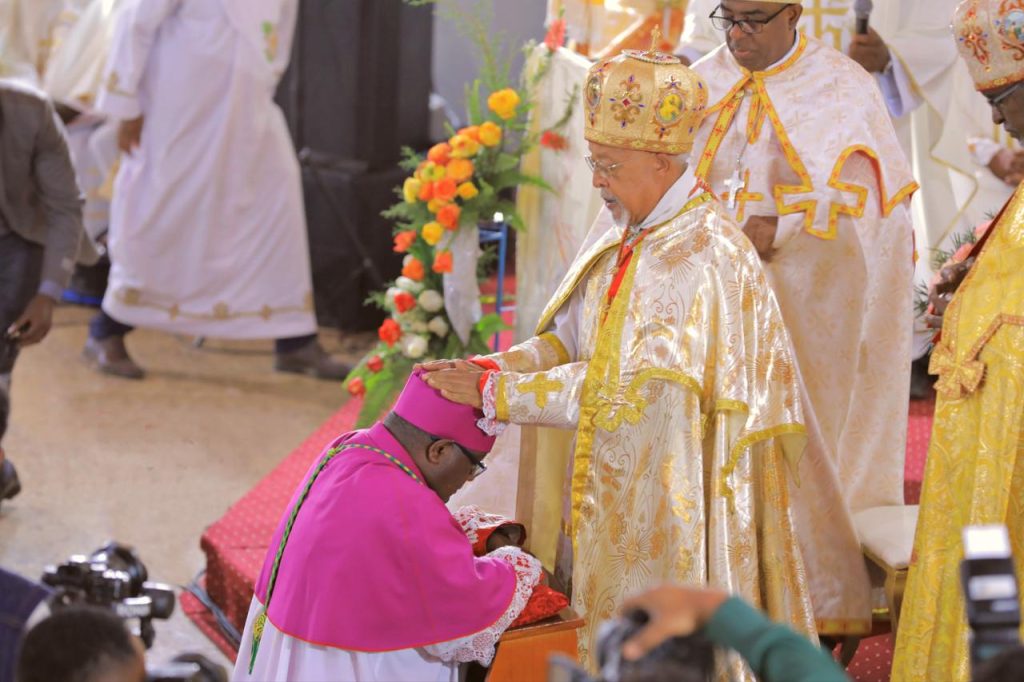
The recently appointed Vicar Apostolic of Hawassa, Ethiopia, was ordained bishop on February 9, 2025, at the Covenant of Mercy Cathedral, ending a long wait of four years for a new bishop for the biggest Catholic circumscription in terms of faithful in Ethiopia.
Bishop Gobezayehu Getachew Yilma – who took the episcopal name Merhakristos (Led by Christ in Ge’ez, the ancient liturgical language in Ethiopia) – was ordained by Cardinal Berhaneyesus Souraphiel, the archeparch of Addis Ababa, assisted by Bishop Abraham Desta, Vicar Apostolic of Meki, and Comboni Bishop Tesfaye Tadesse, Auxiliary bishop of Addis Ababa Archeparchy.
Another seven bishops – six from Ethiopia and one from Nigeria – were on attendance together with over 140 priests, local, from many dioceses and missionaries. There was also a big number of sisters, catechists from the 20 parishes of the vicariate and a huge crowd that filled the Cathedral and three vast tents outside it, containing about 5,000 faithful Catholics.
The joyous liturgy, well organized and participated, was celebrated in the Latin Rite mainly in Amharic and took more than five hours. Prayers were offered in Sidama, Guji, Borana and Gedeo, some of the seven languages spoken in the Vicariate. It was broadcasted by the Ethiopian Pax Catholic TV and the Sidama Media Corporation in the Internet, by FM Radio Fana in three languages, Amharic, Oromo and Sidama, and by close circuit outside the cathedral.
Comboni Missionary Fr Juan Núñez, who was Hawassa Apostolic Administrator for over four years, saluted the ordination event with deep joy.
“The ‘provisional’ period was so long that it seemed to lose its very condition to become a permanent interim. But no one had forgotten the wait, and everyone kept praying for Hawassa to have a Pastor. And the auspicious day has come. Today, February 9, 2025, we are celebrating his consecration and his taking possession of the ‘empty chair’. This is the reason for our joy”, he wrote in his message.
In the speeches at the end of the celebration Msg Massimo Catterin, Charge de affairs at the Vatican Nunciature in Addis Ababa, thanked Bishop Merhakristos for having accepted God’s call to be Hawassa’s Vicar Apostolic.
“Remember that you were consecrated a bishop in the Year of the Jubilee”, he said.
He praised the well organized and participated liturgy and thanked Fr Núñez for his generous service as Apostolic Administrator.
Bishop Merhakristos was born in Dodola, Bale Zone, 46 years ago. Before joining the Meki Major Seminary, he studied agriculture at Jima University. He did his basic theological formation at the Capuchin Franciscan Institute in Addis Ababa being ordained to the priesthood in 2005.
He earned a Masters in Development Studies at Kimmage Development Studies Institute, a License in Divinity in Catholic Social Teaching and a PhD with a dissertation focused on the ethical evaluation of the developmental state paradigm based on the Christian anthropology of John Paul II at the Pontifical University of Maynooth, in Ireland.
Prior to his appointment as Apostolic Vicar of Hawassa, Bishop Merhakristos was Vicar Delegate of the Apostolic Vicariate of Meki and Executive Director of Caritas-Meki.
Bishop Merhakristos, who chose “O Perpetual Help” as the motto for his episcopacy, is the fifth bishop of Hawassa Vicariate and the first Ethiopian to govern it. The previous bishops were all Italian: three Combonis and one Salesian.
The Apostolic Vicariate of Hawassa covers an area of over 100 thousand square kilometres with nine million inhabitants in the South of the Country. It has a total of almost 290 thousand faithful in 20 parishes and 558 chapels.
Two Comboni Missionaries Frs Bruno Maccani and Bruno Lonfernini, both expelled from Southern Sudan, arrived in Hawassa on December 18, 1964, to start a very successful missionary enterprise first among the Sidama e after with the Gedeo and Guji. Later, they were joined by the Holy Ghost Missionaries among the Borana, the Salesians who assumed the mission of Dilla from the Combonis, and the Apostles of Jesus, from Kenya, who took over two Comboni missions, one among the Gedeo and the other among Guji, and who also started the Catholic presence among the Amaro. The Jesuits and the Fidei donum opened one mission each among the Guji.
Currently, the Vicariate counts among its personnel, 531 parttime and 109 fulltime catechists, 74 religious sisters from 11 missionary and one local congregations, 47 religious priests and six brothers from four missionary institutes, 21 diocesan priests, nine major seminarians and two deacons.
José da Silva Vieira e padre Pedro Pablo