
Who We Are
We, the Comboni Missionaries, witness the Gospel through collaboration and dialogue with other cultures and religions, where the presence of God, pervious our arrival, is always recognized. Our attitude, as missionary, is one that learns, respects, and loves the culture of the country in which we are sent.
The missionary vocation calls for service. For us it means to grow in solidarity and to direct our attention towards the“poorest and most abandoned” just as St. Daniel did and put all his passion for them.
We are a religious group of Priests and Brothers
We are a family of priests and lay brothers, present in 36 nations on four continents, Africa, America, Asia, and Europe, who consecrate their lives to the proclamation of the Gospel to all peoples and sharing our faith with them. We live alongside the neediest, the rejected and the marginalized, promoting the dignity of every human person, the defense of human rights, the promotion of social and environmental justice, peace and reconciliation.
We are a big family,formed by one founder
We are part of the large “family” that Comboni founded; it is made up of around 3000 missionaries that includes our Institute, the Comboni Missionaries of the Heart of Jesus (MCCJ), the Comboni Missionary Sisters, the Comboni Secular Missionaries,and other groups of lay people, the Comboni Lay Missionaries, who are inspired by the same charism and are widespread in many nations.
We are moved by the urgency of proposing to everyone we meet the encounter with the person of Jesus Christ as friend and savior, as the only one who can give meaning to the lives of all human beings, bringing wholistic salvation.
“The Comboni Missionary must be “holy and capable.”
Two expressions of Saint Daniel Comboni have remained engraved in the heart and
in the missionaries’ imagination of him:“meat for the slaughter” and “hidden stone”
(Writing 5683) & (Writing 2701)
Comboni’s profile for his missionaries
Daniele Comboni describes in his letters some of the characteristics his missionaries should have to be part of his Institute:
Readiness to die for God
Comboni highlights one of the characteristics his missionaries should possess and live out: their willingness to die for God and for the souls of the Africans. He wrote: the missionary must be “meat for the slaughter” (Writing 5683)
Holy and Capable
If Comboni’s missionaries take seriously that requirement of their call, they must be “holy and capable”: that is, far from sin, but he must also burn with charity (Writing 6655).
Without interest to see fruits
Comboni repeats constantly that his missionaries must be “willing to die without seeing the fruit” of his work (E 2700); willing to suffer great things for Jesus.
A hidden stone
Another expressions of Monsignor Comboni that have remained engraved in the hearts and imaginations of the Comboni Missionaries is that they should see themselves as “hidden stone” (Writing 2701). The Comboni missionary must reveal in his apostolic work and in his lifestyle the awareness that the regeneration of Africa is the work of God.
A servant for the happiness of the poor
He must be humble and see himself as a servant that has the task of acting with the greatest discretion, of believing and waiting; speaking to people with the language of the heart, trusting people and firmly believing that the future of people will be happy only if the poorest and most abandoned on earth become protagonists of their own liberation.
Summary fromFather Carmelo Casile’s sharing.
Characteristics of Comboni’s charism in today’s mission
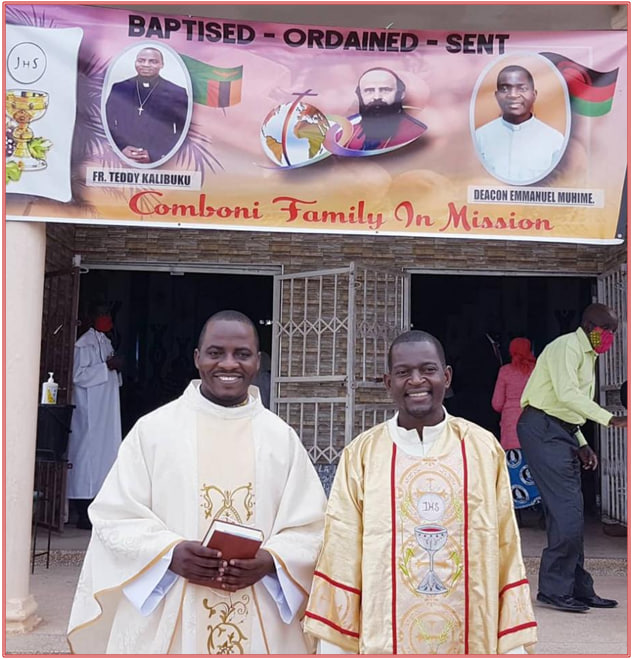
In stating ‘who we are’, there are some characteristics the missionary must take at heart as he preaches the Gospel, following Comboni charism or style of doing mission:
A. We aremission by proclaiming the Kingdom of God.
The proclamation and witnessing of the Kingdom of God is expressed especially through the following values:
- life as gift and presence of God,
- truth, justice, peace, reconciliation,
- integrity of creation,
- freedom and integral liberation from all forms of enslavement,
- the primacy of persons over things and institutions, of man over work, of work over capital, of the universal destiny of goods over private property, of ethics over technology, of mercy over justice.
For Comboni the absolute priority of the Gospel was clear in so far as the missionary must consider himself as sent to serve only the Kingdom of God. The Good News is the mystery of Christ, the mystery of death and resurrection that must be mediated in the present time through gestures and attitudes which manifest the love of God.
B. We are mission in dialogue.
This dialogue is to be cultivated and promoted in all its expressions: religious, intercultural, social, political, the promotion of multi-ethnic fraternity in all nations and in the various continents facilitating the birth of local Churches that are ethnically diversified, through the inculturation of the faith.
C. We are mission in inculturation.
Inculturation understood as presenting the Christian experience of a local Church in the culture of its people, expressed, and communicated with the elements of this same culture while also becoming a force animating, orienting, and facilitating the growth of the said culture, thus contributing to its renewal and enriching the life of the Universal Church.
D. We are mission with option for the poor.
The option for the poor is an evangelical choice giving credibility to the work of evangelization, proving its authenticity when it allows the poor to be Church and helps the Church to be more evangelical, poor and of the poor – a Church that is the pilgrim people of God, a community that is alive and at the service of the Kingdom according to the vision of the Second Vatican Council. Such an option includes denouncing the economic and cultural dependence of many peoples who have become victims of exploitation.
E. We are missionindiscipleship.
This is the call of the Father to follow Jesus and to continue his mission with the strength of the Spirit aware that we are not the owners or the protagonists of mission, but simple collaborators, servants of a project that belongs to the Father, that grows in the measure that we become disciples of the Son, putting our trust in the presence of the Spirit in history, in local cultures, in the Church and in men and women of good will.
F. We are mission in collaboration.
The collaboration with the local Church and with other missionary agents is one more of the characteristics of our missionary vocation and charisma.