
I am AbebayehuTefera Atara. I grew up in HaroWato after being born in HaroAdama. Being the first born of nine children—six boys and three girls—I grew up in a modest family. We are made to value the kindness and fear of God in others.
While my father is a quiet man who works hard and is like a pillar of the home, my mother was a teacher and a light. They both helped me become resilient in the face of the obstacles and problems I encounter in life. They gave me a lot of encouragement to concentrate harder on my schoolwork.
Even so, God has his own way of handling situations in life. My profession was inspired by my parents’ devout appearance, their faith, and their spirituality.
Thus, upon completion of my studies, I enrolled in Addis Ababa’s postulancy, then moved on to the Novitiate in Namugongo, Uganda, and finally the Scholasticate in Nairobi, Kenya. Here’s what came to fruition when I was thinking about what it means to be a priest.
A life of joy, lifting the cup of blessings, and sipping the cup of salvation for me personally is what it means to be a priest.
Being a priest is a profound calling that invites people to dedicate their life to a higher purpose; it is more than just a profession and job.
For me, being a priest entails more than just carrying out the customs and duties typical of religious authority. It is a path of spiritual development, selfless service, and kinship with the community and the Almighty.
Fundamentally, a priest’s role is to act as an intermediate between the religious and the secular. In addition to offering consolation in times of need and establishing a sense of community within the congregation, it entails mentoring and encouraging people on their spiritual journeys. It is an obligation that penetrates people’s lives who are looking for direction and clarity and goes beyond the boundaries of the church.
As guardians of the community’s spiritual health, priests play a crucial role in maintaining it. This entails not just presiding over worship sessions and delivering sacraments, but also listening with empathy, giving guidance, and living up to the ideals of love, compassion, and empathy. The priest may have a great influence on the human experience by the honor of taking part in life’s significant events, such as weddings, funerals, and baptisms.
In the other words, a priest’s life is an ongoing process of self-improvement. It necessitates a dedication to a life of introspection and prayer. The priest’s ability to lead people on their own journeys is enhanced by their constant search for a greater comprehension and connection with the divine, which also enriches their spiritual lives.
Promoting inclusion and understanding is another goal of the clergy. Establishing a warm and accepting environment where people feel free to discuss their faith, ask questions, and get assistance without worrying about being judged is what it entails. In order to be a source of unity that surpasses differences, a priest must embrace diversity among the congregation.
Finally, being a priest is, at its core, a holy and complex vocation. It calls for a strong sense of social responsibility (which I can say is burden for religious to mingle oneself and take initiative with the life of society), a deep commitment to spiritual development, and an unreserved commitment to living out the teachings of compassion and love.
A priest’s path is not without difficulties, but the benefits come from the positive changes they bring about in the lives of the communities they serve as well as in themselves.
Life of priesthood as I understand that it’s not for oneself, rather is for others: as Jesus said, “just as the Son of Man came not to be served but to serve, and to give his life as a ransom for many” (Mt. 20:28).
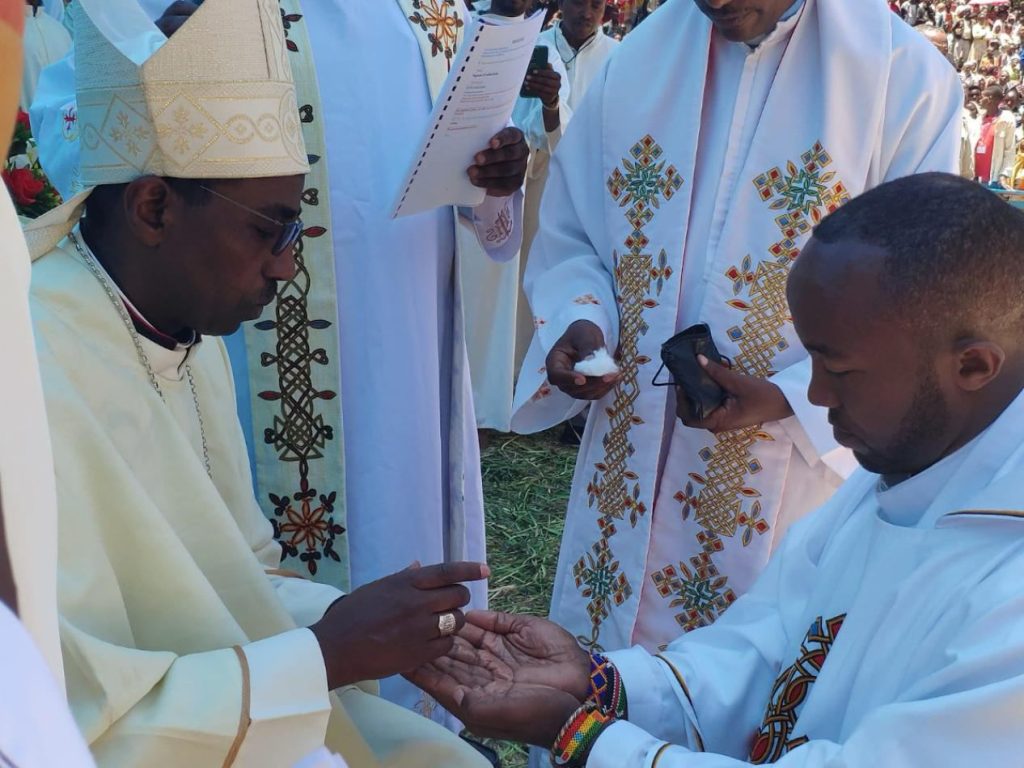
The priesthood ordination celebration
The Catholic Mission of HaroWato in the Apostolic Vicariate of Hawassa, Southern Ethiopia, has offered its first priest to the Comboni Institute. Deacon Abebayehu Tefera Atara was ordained to the priesthood on March 16, 2024.Bishop SeyoumFransua, Apostolic Vicar of Hosanna, presided over the Eucharist and conferred the ordination in Guji language.
Deacon Abebayehu chose as his ordination Gospel Peter’s triple confession of love (John 21: 15-19).During his homily, Bishop Seyoum praised the work of the Comboni Missionaries during the past 29 years in HaroWato. “Abebayehu’s ordination is among the first fruits of this missionary work”, he said. Underlining Jesus’ missionary mandate, the bishop told the deacon to be ordained: “Go out everywhere, proclaim the Good News and perform the sacraments. The Lord who called you is always with you”.
At the end of the Eucharistic celebration, Fr AsfahaYohanes, the Provincial Superior of the Comboni Missionaries in Ethiopia, announced that newly ordained Fr Abebayehu goes to Mozambique:
“A priest is a servant of the Gospel, by the power of God. Pray for him”,
Fr Asfaha said.
Notes:
- HaroWato Mission was started in 1995 by the Comboni Missionaries as an offshoot of Qillenso Mission in the Uraga Mountains among the Guji and Ghedeo peoples.
- The mission opened a junior secondary school from grades five to eight.
- The Comboni Missionary Sisters arrived two years later to open the clinic and the women’s program.
- The Sisters also run a school from kindergarten to grade eighth in neighboring Sollamo town.
- HaroWato mission counts 49 outstations clustered into eight zones.Its baptismal book registers more than 19 000 entries.
Joe Vieira, mccj