
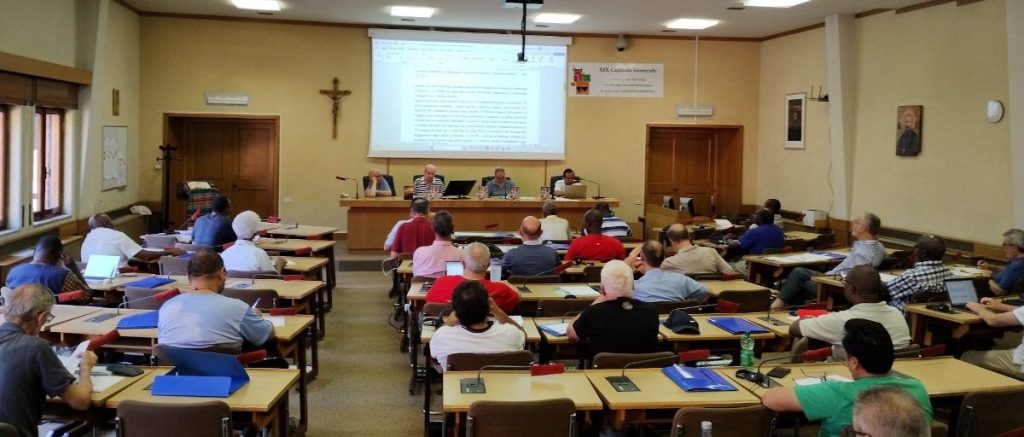
On July 12, 2024, Father Arlindo Pinto, director of the Communications Office at the General Curia in Rome, was invited to speak to the formators of the Comboni Institute gathered at their General Formation Assembly, held in Rome from July 8-27. The theme chosen was “The importance of the use of the media and information in Comboni formation.”
1. COMMUNICATION AND INFORMATION MEDIA AND COMBONI FORMATION
The purpose of this contribution of mine is to awaken our attention to the urgent and serious issue of how the missionary formation offered in our postulancy, scholasticates and international brother centers (CIF) is combined with the role played today by the media and information and the entire digital world.[1]
According to data published in early April 2024, about 5.44 billion people (i.e., 67.1 percent of the world’s population) have access to the Internet and make his of social media. The number of people “not connected” to the Internet has dropped to 2.66 billion, mostly living in South or East Asia and Africa.
Other information strikes me as important: Internet users continue to grow (178 million new users in the 12 months leading up to April 2024); the vast majority of Internet users (96.3%) use a cell phone to get online at least once a day; cell phones now account for the largest share (57.8%) of the time we spend online and 60% of the world’s web traffic.[2]
What is behind these figures, along with the growth of social media and the spread of Artificial Intelligence-authentic “new signs of the times”-has changed our reality in many ways that we could never have imagined; in truth, it has created a new world and a new culture, to the point that there is already talk of a “new digital continent.” In addition, new doors have been opened for formative, teaching and learning processes and a new online space has been created, that is, a new “territory” for our pastoral, vocational and missionary activities.[3] It must be said, however, that we will not be able to be adequately present in the new digital culture without first understanding it.
As Comboni formators, we know that this new world cultural reality requires adequate preparation and formation, which we are called to acquire if we want to enter it and create new styles of evangelization, vocation promotion and digital mission.[4]
I am aware that I am not telling you anything new. Yesterday, Father José de Jesús Villaseñor Gálvez, General Secretary of Formation, listed for you the general motions of the APDESAM (Assembly of the Provincials and Delegates of English-Speaking Africa and Mozambique) Formation Assembly celebrated in July 2023 in Nairobi. One of them particularly struck me: “The missionary and responsible use of the Mass Media and the Internet is recommended in order to carry out missionary animation, vocation promotion, and material resource retrieval.”
I am sure that the vast majority of us-particularly the younger, postulants, novices and scholastics (the so-called “digital natives”)-are now “inhabitants” of this still rapidly changing digital environment. We can no longer avoid and ignore it! Instead, we are called to become missionaries of this “digital continent” and “online formators,” animated by the action of the Spirit, following the example of the Lord Jesus, the “Master of Communication,” and of our Founder, St. Daniel Comboni, himself an unsurpassed “communicator.”
One of the most innovative means of communication that has revolutionized the way we communicate and live and cannot be forgotten is the cell phone (smartphone). This medium has not only expanded the space of human relations and shortened connection time, thanks to digital technologies, but has become an inseparable extension of our bodies. We can forget everything but the cell phone! And if it is true that the cell phone is now an (almost) natural part of our bodily being, this means that “it is (almost) forbidden to ban it.” We just have to learn how to use it. I repeat: it is not the electronic media (cell phones, tablets, laptops…) that are the main problem or challenge, but our training in their daily use.
I have my own “theory” about the use of the smartphone, as well as all other digital media: “the smartphone is like the knife.” The knife is a useful and necessary “good,” but it can be used to do both good and evil. The same goes for new media: they can be both bad and good; one must learn to use them well. In a technological world such as ours, in which human connectedness is a constitutive condition of our collective life, the best and most effective way to assimilate and ensure the proper use of digital media necessarily comes through serious and comprehensive education in their use, both at the basic academic level and in continuing education. It is not difficult to deduce that the poorer such education is, the greater will be the lack of responsibility and critical thinking in how to use them. Only proper and continuous training in their use will be able to provide us with both.
Therefore, educating ourselves in the use of the media and information and communication in general means, first of all, educating ourselves and educating ourselves in critical thinking and discernment. And it is up to the Institute and you trainers, in particular, to ensure “digital literacy,” providing your “trainees” with the appropriate tools and criteria (technical, scientific and ethical) on how to deal with new technologies and the avalanche of information that invades us daily.
2. MEDIA RESEARCH IN COMBONI HOUSES OF FORMATION
As I was thinking about what I could tell people like you who are in charge of formation in our Institute about the importance of today’s media and information, particularly in the formation context of our young candidates, the curiosity arose in me to know how many Comboni communities are engaged in the field of formation and how many of them publish a bulletin-newsletter (or another medium of communication) or are present on the “digital continent” in an official way. All I could do was patiently go and check how many have one or more official media (print or digital on the Internet) or an account on one of the many digital social platforms. In fact, only a significant and constant presence in the digital world would allow us to share both internal and external initiatives (in terms of pastoral and evangelization activities, experiences of missionary animation and vocation promotion) with the other communities of the Institute, with friends and benefactors, family members and other interested people, and especially with young people.
3. CONCLUSION.
From the data I was able to gather and especially from the conversations I had with the participants in the General Assembly, I think I can say that a large part of the formators is already more than convinced that issues related to communication, information and the use of digital media cannot be absent both in the various stages of the formation process offered to our candidates and in the ongoing formation initiatives proposed to all the confreres. But recognizing their importance is not enough. In the short term, concrete formation projects in this regard will have to be put in place.
It seems to me that I can say, without a shadow of a doubt, that our formation communities (in all their phases) still have very little presence on the “digital continent,” although, in my opinion, they would already have the capacity to be much more present at all levels. All it would take is to want it!
We can no longer doubt that modern means of communication and new digital platforms offer excellent conditions and open doors for those who want to use them for more widespread evangelization, more incisive missionary animation and vocation promotion, and even ingenious fundraising (fundraising).
Ultimately, the worldwide cultural change generated by new digital communication and information technologies can no longer be discarded or ignored in our formation processes.
Fr. Arlindo Pinto, MCCJ
Communications Office Director Rome, August 2024