
Why Catholics celebrate Easter on March 31 and the Orthodox on May 5? Comboni Missionary, Fr.
Joe Vieira, gives the answer to this question.
Easter in May.
Most Christians celebrate the Easter of the Lord’s Resurrection on March 31. The Orthodox Communion celebrates it on May 5. Different calendars dictate different dates. The rule for celebrating Easter is simple and was established 1700 years ago by the Council of Nicaea in 325: the resurrection of the Lord is celebrated on the Sunday after the full moon of the spring equinox.
However, this year, while Catholics and other Christians celebrate Easter on March 31, the Orthodox do so on May 5. Why? While Catholics and Protestants celebrate Easter according to the date of the Gregorian calendar, which has been imposed as the universal counter, the Orthodox communion follows the old Julian calendar, in force since almost half a century before Christ was born, which was replaced by the Gregorian in 1582 to settle the accounts of the solar year.
The two calendars have a difference of 13 days at the beginning of the month. For this reason, the date of Easter varies between March 22 and April 25 according to the Gregorian calendar and April 4 and May 8 according to the Julian calendar.
Can we celebrate Easter on a common date again? The two calendars coincide from time to time. Next year, the Eastern and Western churches will celebrate on Sunday, April 20. The Synthesis Report of the first session of the XVI Ordinary General Assembly of the Synod of Bishops, which took place last October, mentions the coincidence: “Providentially, the date of the solemnity of Easter will coincide for all Christian denominations [in the year in which the 1700th anniversary of the Council of Nicaea is celebrated]. The Assembly expressed a strong desire to find a common date for the feast of Easter, so as to be able to celebrate on the same day the resurrection of the Lord, our life and our salvation,” read the proposals presented for Christian unity.
The Orthodox Patriarch of Constantinople also expressed the desire for Christians in the East and West to celebrate Easter on a “unified date”: “It is a scandal to celebrate separately the unique event of the one resurrection of the one Lord,” said Patriarch Bartholomew in his homily on March 31, the day he sent delegates to greet the churches celebrating the Lord’s Easter in Constantinople. The need for a common celebration of Easter was also expressed by Pope Francis in June 2015, when he told the participants of the world retreat for priests that “we have to agree” on a common date for Easter.
Same date, different celebrations
Ethiopia celebrates its Christian feasts according to the Julian calendar and the Catholic Church also
follows it in its two rites, Eastern and Roman.
The Catholic Church was re-established in Ethiopia in the 19th century under two rites: the Eastern, in the north (where the population is predominantly of Semitic origin and follows the Ethiopian Orthodox Church); and the Roman, in the south (among the more Protestant and Catholic Cushite ethnic groups). Two great Italian missionary bishops were the protagonists of this dynamization: Saint Justin of Iacobis and Cardinal William Massaia, respectively.
The two Catholic traditions use different liturgical practices. Catholics of the Eastern Rite begin Lent two weeks earlier than those of the Roman Rite, following the Orthodox tradition of a 55-day Lent, celebrated in its own way with daily fasting after dinner and until noon or 3pm the following day. During this time, they follow a typically vegan diet, abstaining from all animal products: meat, milk, eggs… Orthodox butchers are closed during Lent, but Muslims and others remain open. Latin Rite Catholics fast on Ash Wednesday and Good Friday and abstain from meat on Fridays. During the Lenten celebrations, the liturgical palms, keyboards and drums, flowers and ornaments are kept in the storage room until Easter.
The celebration of the Lord’s Passover is also different. The Eastern liturgy is celebrated indoors and does not include the rite of new light or the renewal of baptismal promises, which takes place during the celebration of Timket, the Baptism/Epiphany of the Lord, on January 19. The Easter Vigil begins at 7pm and lasts through the night. The women wear predominantly white (new or clean clothes). The men cover themselves with a white cloak.
During the celebration, the assembly listens to eleven biblical readings (ten passages from the Hebrew Scriptures and one from the Gospel of John) plus two texts from the ancient Fathers. At midnight, a traditional song announcing that the Lord is risen is proclaimed. The liturgy lasts until near dawn, with lots of singing, prayers, processions around the altar, incense and candles.
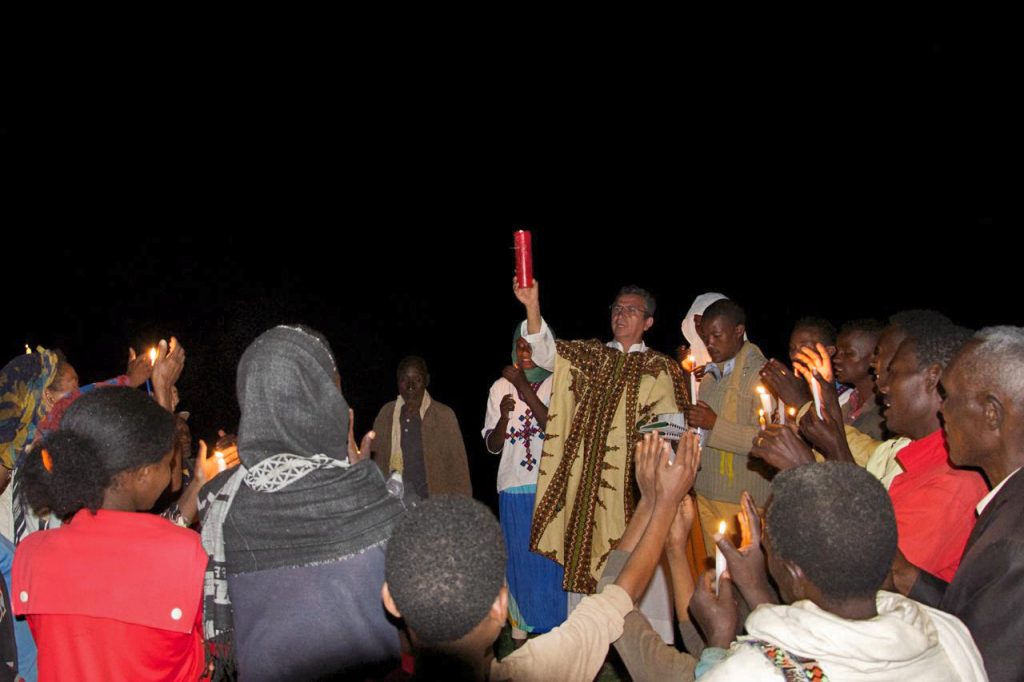
After church, Easter is celebrated at home by breaking the fast from meat. Depending on the family budget, each family cooks a lamb, kid or chicken. Traditional alcoholic drinks are also part of the Passover menu: tela (home-brewed beer) or tej (a fermented drink made from honey and water). The Roman Easter rites are the same everywhere, translated into the local languages. The celebration begins after sunset with the blessing of the new fire, outside the temple, and continues with the celebration of the Word (which can have up to seven readings from the Jewish Scriptures and two from the Christian ones, including the proclamation of the Gospel of the Resurrection; between each reading it is customary to sing a hymn or psalm).
This is followed by the baptismal liturgy in which, on the one hand, the faithful renew the promises they made on the day of their baptism and, on the other, the catechumens, people who have been preparing for admission to the Catholic Church for a year or more, are baptized. The mother of all vigils concludes with the Eucharistic liturgy. All together, it takes between three and four hours.
There’s no hurry!
Easter is also a time for people in the South to renew their closet, but by dressing in different colors. They also eat an improved meal, which usually includes a dish of chicken cooked with a few eggs in a thick, spicy syrup, accompanied by injera, traditional Ethiopian bread made with tef, an indigenous cereal, in the style of a giant pancake. Family members visit each other to say hello and sample the Easter lunch. José Vieira is a Catholic priest and a member of the Comboni Missionaries. He works among the Gujis of southern Ethiopia.
The photos in this article show a Mexican Comboni Missionary, Fr. Pedro Pablo Hernández, celebrating the Easter Vigil in the last years in different chapels among the Guji. Recently, he sent out a message on social media forwarding the news the of the desire by varios religious leaders to agree on a common date for the celebration of Easter in all the Christian world.
José Vieira, Qillenso (Ethiopia) | May 1, 2024