
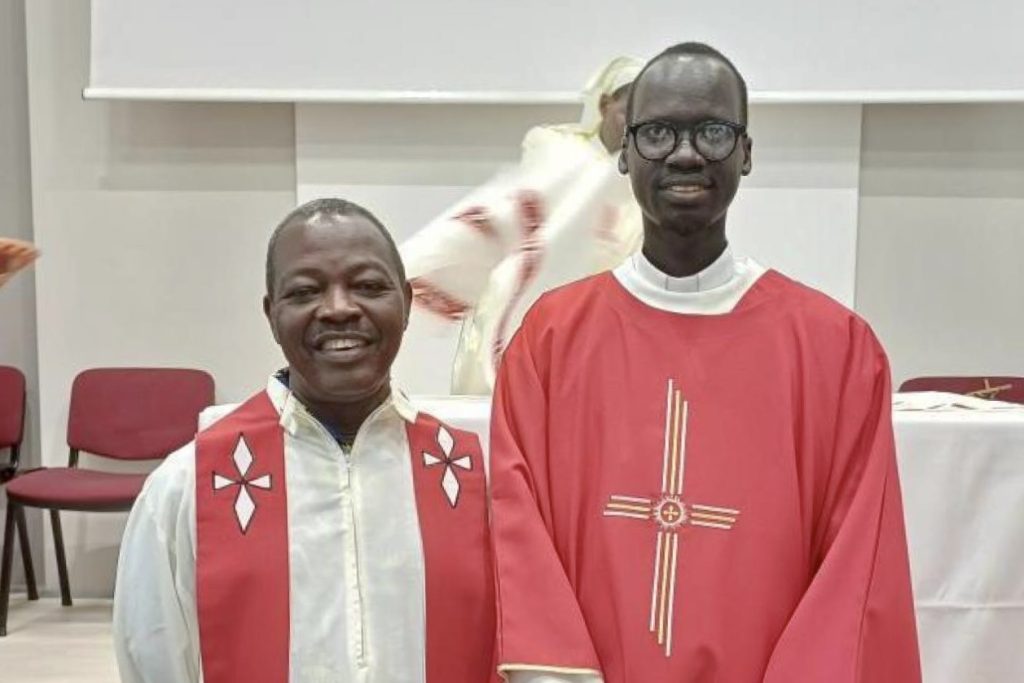
Congolese Comboni missionary Fr. Emmanuel Denima Darama teaches philosophy at the major seminary in Juba and he shares with us his experience of ten years of teachingand how he participates in “building the church of tomorrow.” (In the picture, Fr. Emmanuel, on the left with a young priest).
My assignment is to teach philosophy at St. Paul’s Major Seminary in Juba, an institution that the Comboni Missionaries helped to found. We welcome seminarians from the seven dioceses of South Sudan and two from Sudan. The two countries form a single bishops’ conference, and this is their only seminary. Although for a time the seminary moved to Khartoum because of the war, in 2011, after South Sudan’s independence, it returned to Juba, its original location.
I found it difficult to accept this teaching position, to which I was appointed in 2014. My desire was to return to some of the Sudanese parishes where years before I had done rewarding pastoral service. The task of teaching is not so rewarding because it requires a lot of preparation, but I gradually discovered the importance of what I do.Philosophy helps us to think and endows our students with a critical spirit that helps them to free themselves from sentimentality.
I feel that my service is one hundred percent missionary because I work to build the Church of tomorrow. I do not live in the seminary but in the community of Moroyok, where I accompany young aspiring Comboni Missionaries.
The seminary is located 13 kilometers from our home, and I go there from Monday to Friday to give classes. A team of about eight diocesan priests from different parts of the country manage the institute and the formative accompaniment of the seminarians. They are all residents. The school year begins in March and ends in December. This year we have about 150 seminarians with three years of philosophy and four years of theology.
One of the most serious problems we have is the low educational level of the students and their poor knowledge of English, which is the language we use to teach.
In addition, all of our students have directly or indirectly experienced war and are sometimes a bit violent. However, the fundamental challenge we face is tribalism, which is much stronger in South Sudan than, for example, in my country, the Democratic Republic of Congo.
People identify very much with their ethnicity and the Dinka, for example, consider the Nuer as their enemies and vice versa. Since their arrival at the seminary, we have tried to help the students get to know each other better and improve their interpersonal relationships. Although in the first years they always form small groups, by living together they realize how false ethnic prejudices are and begin to make friends. This is a wonderful thing to see.
Other difficulties we face are power cuts, the poor quality of our library, especially the philosophy library, or the desperately slow Internet connection. Another problem of concern is the high number of dropouts in the last years of school. When seminarians have a solid education, instead of serving the Church, some tend to look for a job in an NGO or international organization that pays well. Thanks to the support of the Holy See and some international organizations, the seminary has good facilities and all the theology students have their own rooms. I have been in Juba for ten years, so some of my former students are priests or deacons working in their dioceses. This gives me great satisfaction because I see that my efforts are bearing fruit for the good of the Church. By: Fr. Emmanuel Denima, mccj